

Unusual Luxury Perfumes: Discover Fragrance Beyond the Familiar
What if unusual luxury perfumes aren’t a test of how daring you are, but an invitation to notice what draws you in? The word “unusual” can conjure scents that feel difficult to picture or too challenging to wear. Yet a fragrance can feel distinctive through its mood, its unexpected contrasts or simply the way it settles on your skin.
If fragrance descriptions have ever left you unsure where to begin, you’re not alone. Choosing something less familiar needn’t mean taking a leap into the unknown. It can be a gradual, personal discovery, guided by what feels inviting rather than what sounds bold on paper. This article explores what unusual can mean in luxury perfumery and how to find a scent that feels like yours.
We’ll share a considered edit featuring Andevalo, Ambre Noir, Carduus and Amber Narcotique, then offer a practical way to explore fragrance before you choose. Along the way, you’ll find ways to move beyond abstract descriptions and compare the impressions that matter to you. For a more personal exploration, Dot Perfume Gallery also offers private perfume consultations by appointment on Tuesday to Thursday evenings.
Key Takeaways
- “Unusual” is a personal impression, not a strict perfume category. Notice what feels distinctive to you rather than searching for a particular label.
- Explore unusual luxury perfumes through each fragrance’s description, then consider which impressions feel inviting or intriguing.
- Compare scents by mood, familiarity, setting and personal associations, not by an overall ranking.
- Give a perfume time to settle before deciding. Your response may change beyond the first impression.
- Discover different perspectives on fragrance through houses including Flâner, Floris, Angela Flanders and Jorum Studio.
What makes an unusual luxury perfume feel distinctive?
Curiosity about a scent beyond the familiar is a lovely place to begin. Perhaps the fragrances you recognise most readily no longer feel quite like you, or you’re drawn to descriptions that suggest a different mood. Yet “unusual” can sound more intimidating than it needs to. It doesn’t point to one precise style, ingredient or technical classification. It describes the impression a fragrance makes on a person.
An unusual luxury perfume is a fragrance that feels distinctive to the wearer through its character, mood or personal associations, rather than belonging to a fixed technical category. What seems unexpected to one person may feel comforting to another. Familiarity is shaped by the scents you’ve encountered, the memories you connect with them and the patterns you’ve learnt to recognise. For background on the idea of niche perfumery, which often overlaps with the search for less familiar fragrances, explore Niche Perfume.
Unusual does not have to mean unwearable
A fragrance may feel distinctive because its elements create contrast, or because its overall character differs from the styles you usually reach for. That contrast needn’t be loud or difficult. Sometimes the difference lies in the way a composition shifts your expectations, or in a mood that feels new without seeming uncomfortable. When you read a perfume description, focus on the words that appeal to you and the impression they create, rather than assuming that a striking name means a challenging scent.
Noticeable and challenging aren’t the same thing. A perfume can catch your attention while still feeling easy to wear, just as a quieter fragrance may feel unfamiliar because it sits outside your usual preferences. Nor must a distinctive scent be reserved for an evening or special occasion. Your own sense of comfort, setting and personal style matters more than a rule about when an unusual fragrance belongs.
How luxury fragrance invites a more personal discovery
Luxury can be experienced as a more attentive encounter with fragrance: the way a composition unfolds, the care given to its presentation and the space it leaves for your own response. Rather than judging a perfume only by a list of notes or by whether it resembles something you already know, slow down and notice how its description meets you. Then, if you can sample it, compare that first impression with your experience of the scent.
Give the description room to spark an impression, then stay curious about your response. Does the idea feel intriguing, soothing, vivid or simply unfamiliar? You needn’t decide at once whether a scent is “for you”. Interest is enough to begin. Comfort can be discovered gradually, as you explore what feels distinctive without asking yourself to be more daring than you are.
Four unusual luxury perfumes to discover through their own character
A considered edit can be more helpful than a long list, especially when fragrance descriptions are hard to picture. Andevalo, Ambre Noir, Carduus and Amber Narcotique are four perfumes to explore at Dot Perfume Gallery. Rather than placing them in a ranking, read each perfume’s description and note what catches your attention. A few words about mood, character or setting can help you decide which one you’d like to discover first.
Andevalo and Ambre Noir: two starting points for exploration
Begin with Andevalo, taking its description on its own terms rather than assuming its name tells the whole story. The Andevalo perfume guide offers a way to explore its scent and character. Ambre Noir makes a second point of comparison; its Ambre Noir perfume guide gives you another description to consider. Read them side by side and note the words that appeal to you in each. That gives you a practical starting point for comparing your reactions without expecting one fragrance to suit everyone.
Carduus and Amber Narcotique: continue the discovery
Carduus and Amber Narcotique extend the edit with two more perfumes to meet through their individual descriptions. Give each the same attention: read slowly, note the phrases that resonate and resist filling gaps with assumptions. A perfume’s name may spark an image, but its description is a more grounded starting point for imagining its character. If you’re comparing several options, jot down a few words beside each name so you can see which impressions keep drawing you back.
A simple comparison framework
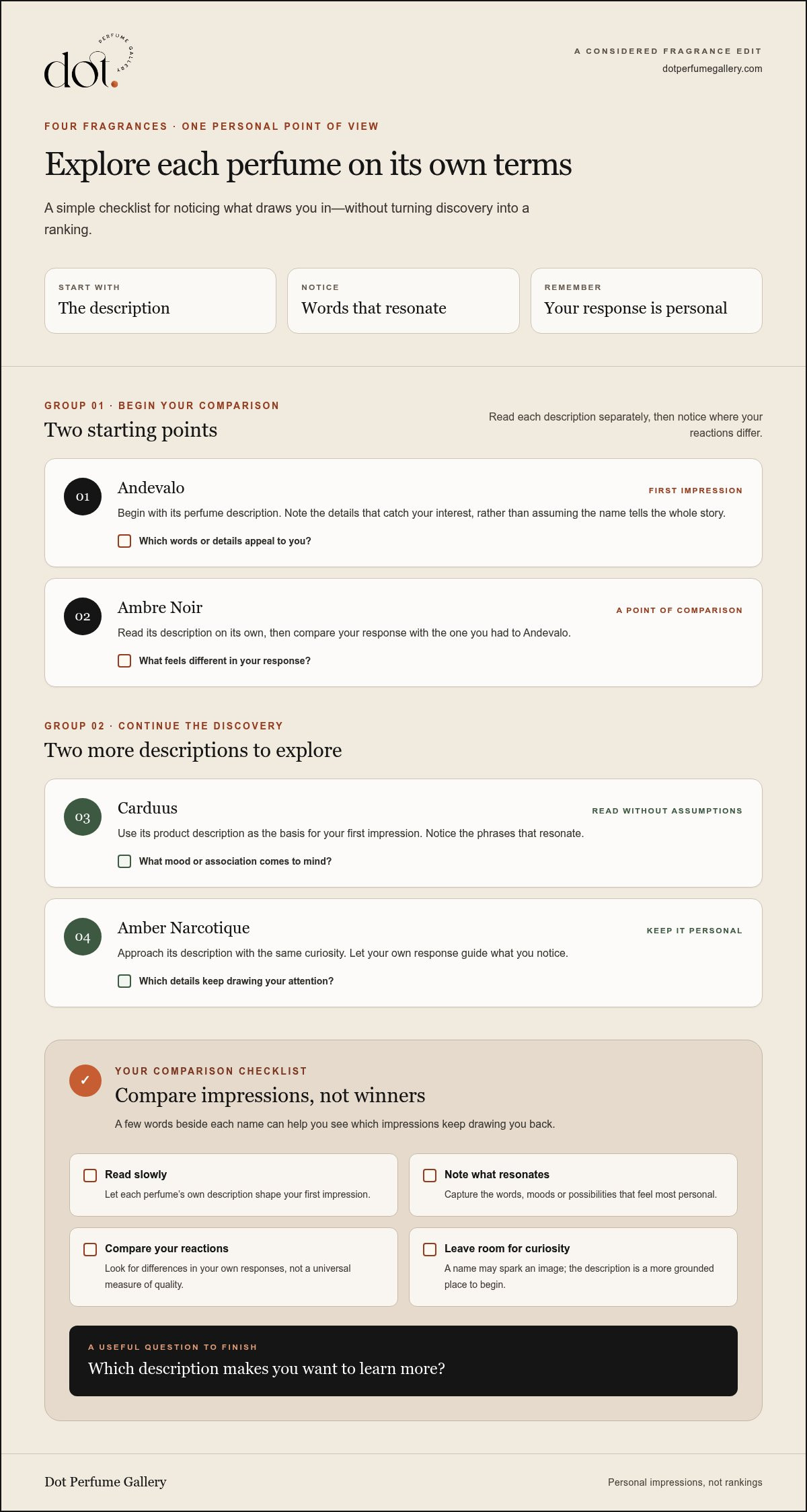
- Andevalo: begin with its product description and note the details that catch your interest.
- Ambre Noir: read its description separately, then notice where your response differs.
- Carduus: use its product description as the basis for your first impression.
- Amber Narcotique: approach its description with the same curiosity, without ranking it against the others.
This is a comparison of your responses, not a verdict on which fragrance is best. Each description can prompt a different mood or association, and those impressions are personal. Most Expensive Perfumes offers another discussion of luxury fragrance, but a price-led perspective needn’t shape how you explore these four. A more useful question is: which description makes you want to learn more?
For a fuller sense of each fragrance, use its own product description for the details rather than borrowing notes or character from another scent. Explore the curated perfume selection at Dot Perfume Gallery and focus on the words, moods and possibilities that feel most personal.
Comparing unusual luxury perfumes without rankings
A useful comparison doesn’t ask which fragrance is best. It helps you understand what you’re drawn to, and why. With unusual luxury perfumes, a description offers a first impression, but your preferences, memories and circumstances shape how that impression feels. One scent may appeal through a sense of familiarity, another because its language suggests a mood you haven’t explored before. Neither response is more correct.
A perfume’s appeal is personal and context-dependent: the same scent can feel different according to your associations, the moment and the setting in which you wear it. Keep that in mind as you compare descriptions. Instead of assigning each perfume a score, use a few steady questions to identify which one feels most worth discovering.
| Comparison lens | Ask yourself | What it can reveal |
|---|---|---|
| Mood and imagery | Which words or images hold my attention? | The descriptions that stir your curiosity or feel emotionally inviting. |
| Familiarity | Does this sound close to what I already enjoy, or quite new? | Whether you’re seeking a gentle variation or a step beyond your usual preferences. |
| Setting | Where might I enjoy wearing a scent like this? | The occasions or routines you naturally associate with its description. |
| Personal associations | Does it bring a memory, place or feeling to mind? | The private meaning that can make a fragrance feel especially compelling. |
Notice the mood and imagery that draw you in
Read a perfume description and pause over the language. Perhaps one phrase suggests softness, brightness, calm or drama; perhaps a setting or texture catches your imagination. Note your response before moving on to another description. Treat it as a clue about your own taste, not a promise that the perfume will smell the same to everyone. Product copy can help you picture a character, but your experience remains your own.
If a description names a particular note or mood, use that detail as a starting point, not as a complete portrait. If it doesn’t, there’s no need to fill the silence with guesses. A simple “this makes me curious” is a useful comparison.
Consider where and when you might enjoy wearing a scent
Think about your everyday routines, a quiet evening or a moment when you want fragrance to feel like personal expression. These aren’t rules about season, occasion or what a perfume is “for”. They’re prompts that bring your own life into the decision. Ask whether a description feels suited to the mood you want to explore, while staying open to being surprised.
Try writing a few words beside each fragrance: one for its described mood, one for how familiar it feels, and one for the setting or memory it brings to mind. Keep the notes simple. Their purpose is to make your preferences visible, so your next discovery can begin with curiosity rather than a ranking.
How to explore an unusual perfume before choosing
Reading about a fragrance can awaken curiosity, but your own experience helps you decide whether it feels inviting. A measured approach gives you time to move from the promise of a description to your personal impression, without expecting an immediate verdict. If you can sample a scent, try exploring it at an unhurried pace:
- Choose a promising description. Pick one that catches your interest, whether through its mood, its language or the sense that it offers something different from your usual choices.
- Experience one fragrance at a time where practical. This makes it easier to notice each scent on its own, rather than blending impressions from several fragrances together.
- Pause and let it settle. Notice your first response, then return to your impression later. There’s no need to follow a fixed timeline or decide straight away.
- Reflect on what you noticed. Consider which parts felt inviting, unfamiliar, memorable or not quite right for you.
Give a fragrance room to unfold
Your first impression is one moment in the experience, not necessarily the whole story. If you can, make a brief note of it, then notice whether anything seems different as you spend more time with the fragrance. You might record a word, a feeling or an association rather than trying to identify technical details. There’s no universal timetable for this reflection; follow your attention and take the time that feels comfortable.
Where you experience a scent may shape your impression too. Skin, surroundings and personal memories can all affect what comes to mind, so the same description may feel different in a quiet moment than during a busy day. Keep this in mind when reflecting on your response: fragrance is experienced personally, not just imagined from words on a page.
Use your own preferences as the final guide
Ask yourself what stayed with you. Was there a detail in the description you kept thinking about? Did the fragrance feel intriguing, reassuring, vivid or simply unfamiliar? You don’t have to like every aspect of a scent for the experience to be worthwhile. Sometimes it helps clarify what you’re drawn to next.
Other people’s reactions can offer ideas, but they can’t decide how a perfume feels to you. If your first response is uncertainty, give yourself permission to pause rather than treating unfamiliarity as an automatic rejection. Equally, you don’t need to persuade yourself to enjoy something just because it has an unusual reputation. The purpose of exploring unusual luxury perfumes is to discover your own response, not to pass a test of adventurousness.
For a more personal way to explore your preferences, Dot Perfume Gallery offers private perfume consultations by appointment on Tuesday to Thursday evenings. You can also explore the curated fragrance selection at your own pace.
Explore unusual luxury perfumes through Dot Perfume Gallery’s curated edit
Exploring unusual luxury perfumes needn’t mean searching endlessly or deciding what your taste should be. A curated selection offers a useful place to begin: a range of fragrance houses and individual perfumes to encounter one description at a time. Dot Perfume Gallery brings together niche, luxury and British fragrances, including Andevalo, Ambre Noir, Carduus and Amber Narcotique. Let your own curiosity guide the next step, whether a particular name has caught your eye or you’d like to discover a house that’s new to you.
A considered selection across independent fragrance houses
Different fragrance houses bring different perspectives to perfume, so exploring by house can be a useful way to follow your curiosity. Flâner, Floris, Angela Flanders and Jorum Studio are among the houses represented at Dot Perfume Gallery. You might begin with a name you recognise, or choose one that feels unfamiliar. Either way, read each description attentively and notice which words or ideas speak to you.
You can also use fragrance family as a starting point if that language helps you organise your preferences. Treat it as a route into discovery, not a boundary around what you’re allowed to enjoy. A description may lead you towards a familiar mood or open a door to something less expected. Keep your own impressions close, and consider each perfume through its individual description rather than assuming every fragrance from a house will share the same character.
When a private perfume consultation may help
If you’d value a more personal way to explore your preferences, a private perfume consultation offers space to consider what you’re drawn to and what you’d like to discover. It can help when descriptions feel difficult to picture, or when you have several impressions but aren’t sure how to bring them together. There’s no need to arrive with a settled answer; curiosity is a perfectly good place to start.
Private perfume consultations are available by appointment on Tuesday to Thursday evenings. Bring the preferences you’ve noticed so far, such as moods or descriptions that appeal, as a starting point for the conversation. The aim is to explore, not to be hurried into a verdict. Your response remains the most important part of the experience.
Whether you prefer to browse quietly or explore your tastes with personal guidance, there’s room to take this discovery at your own pace. Begin with the fragrance houses or perfume names that have stayed in your mind, and let each description offer a fresh point of departure. Explore the curated fragrance selection whenever you’re ready to continue.
Let your next fragrance discovery be personal
The next time a description catches your attention, let curiosity lead rather than asking whether the scent is unusual enough. The most meaningful choice may be the one that brings a quiet sense of recognition, stirs an unexpected memory or simply makes you want to learn more. Unusual luxury perfumes are not a challenge to conquer; they’re an invitation to find a new point of connection with fragrance.
Let your preferences take shape as you explore. Dot Perfume Gallery’s curated edit brings together niche and luxury fragrances from different houses, offering room to follow a mood or discover a fresh perspective. If you’d welcome a more personal conversation as you explore what appeals to you, private perfume consultations are available by appointment on Tuesday to Thursday evenings.
There’s no need to hurry towards a final answer. Begin with a name, a description or a feeling that lingers, and see where it leads. Explore a considered selection of unusual luxury perfumes at your own pace, and enjoy discovering a scent that feels distinctly yours.
Frequently Asked Questions
What makes a perfume unusual?
A perfume feels unusual when its character differs from what you personally recognise or expect. That may come from an unfamiliar impression, an unexpected contrast or simply a mood you haven’t met in fragrance before. There’s no universal measure of unusualness: your past experiences shape what feels new. A scent described as distinctive may seem familiar to one person and intriguing to another.
Are unusual luxury perfumes suitable for everyday wear?
Yes, an unusual fragrance can be part of everyday wear if you enjoy how it feels in your routine. Think about the settings you move through, such as work, travel or time at home, and whether you feel comfortable wearing it there. “Unusual” describes an impression, not a dress code. You don’t need to save a scent for a special occasion simply because it feels different.
How do I choose an unusual perfume if I usually wear familiar scents?
Start by identifying what you already enjoy, then use that as a gentle bridge to something new. You might write down whether you gravitate towards fresh, warm, soft or vivid impressions, then look for a description that shares one appealing quality while suggesting another. This makes exploration feel more manageable than choosing something entirely unfamiliar and helps you follow curiosity without abandoning your usual taste.
Can an unusual fragrance still feel subtle?
Yes. Unusualness and intensity are different qualities: a fragrance may feel distinctive because of its mood or character without seeming bold to you. “Subtle” is personal, too, and can depend on the setting and your own perception. Rather than judging from a name or an evocative description alone, try the scent if you can and consider whether its presence feels comfortable in the moments you have in mind.
How should I test an unusual perfume before choosing one?
Start with a blotter, if one is available, to notice your first response without introducing skin into the experience. If the scent interests you, try it on your skin and pay attention to how you feel as you go about an ordinary activity. Note the setting and your impressions, then revisit your thoughts later. This gives you more to consider than a quick first sniff or someone else’s review.
What is the difference between niche perfume and unusual perfume?
Niche perfume describes a part of the fragrance world, often associated with perfumery created around a particular artistic vision and made on a smaller scale than mass-market designer scents. Unusual perfume describes how a fragrance feels to someone; it isn’t a formal category. The ideas can overlap, but they aren’t interchangeable: a niche scent may feel familiar to you, while a fragrance from another category may feel unexpected.
Are unusual luxury perfumes a thoughtful gift?
They can be, especially when you know something about the recipient’s preferences. Think of fragrances they already enjoy, the moods they’re drawn to or a scent they’ve mentioned wanting to explore. A less familiar choice can feel personal when it reflects that knowledge, rather than being selected only because it seems unconventional. If you’re unsure of their taste, a conversation about fragrance may be more thoughtful than guessing.