

Carduus perfume scent profile and development
Carduus perfume moves from aromatic tea and sage through soft florals and warm spice to a deeper, woody sweetness. Its listed notes include tuberose, clove, pepper, honey, rose, chocolate, heliotrope, musk and tobacco. As the Texas cedarwood dries, it becomes sweeter and more resinous, with a faint smoky, cade-like quality. The scent is described as lasting around six hours after application.
A fragrance can feel different as its brighter, aromatic facets settle into the heart and dry-down. If you’re curious about what gives Carduus its character, this guide explores its heart notes, how the cedarwood develops, and how its projection and scented trail are described, helping you picture how it may wear on skin.
Key Takeaways
- Follow the fragrance from its aromatic opening towards a warmer, woodier dry-down to understand how its character shifts.
- Notice how tea, sage, florals and spices contribute different shades to the overall scent, rather than reading the notes as a simple list.
- Pay attention to the cedarwood’s sweeter, resinous and faintly smoky qualities as it develops on the skin.
- Learn what the reported wear time can suggest, and how projection and a scented trail shape the fragrance’s presence around you.
- Explore sensible ways to approach fragrance if your skin is sensitive, while keeping scent preference distinct from skin response.
Fragrance character and development
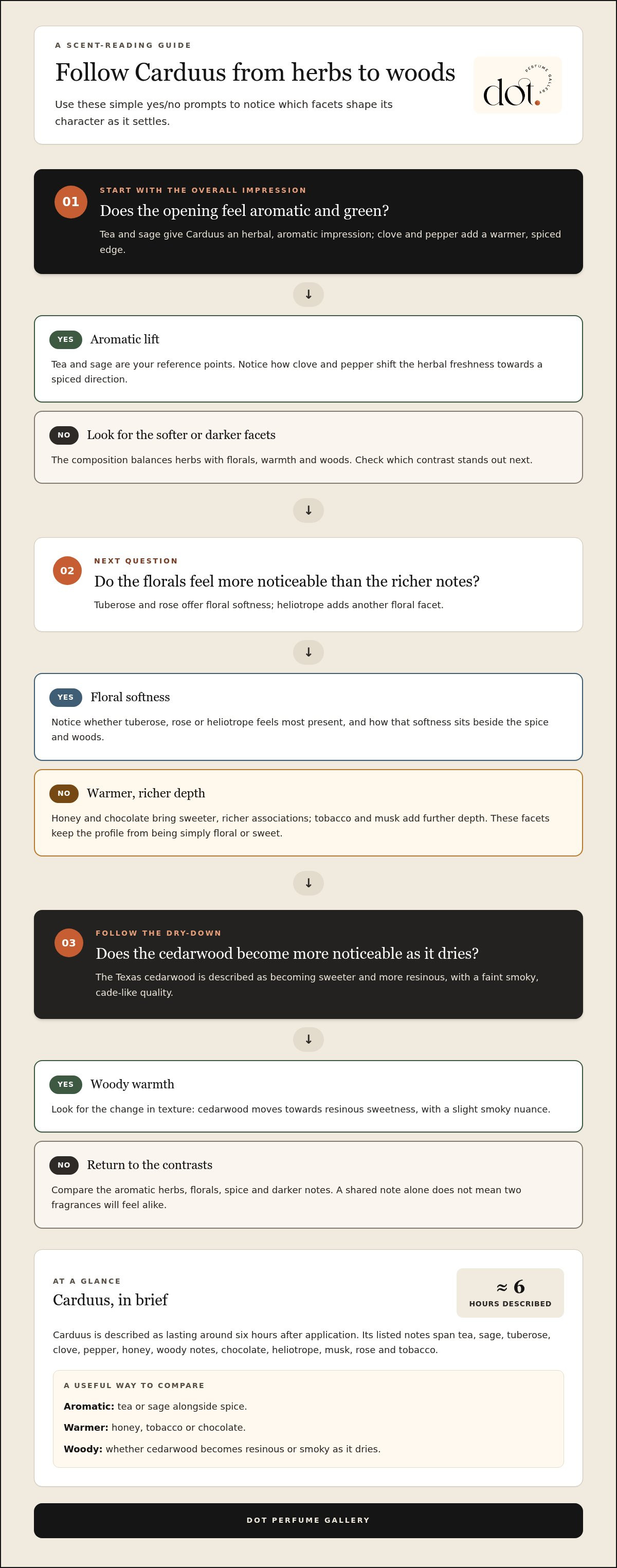
Carduus is an aromatic, unisex fragrance shaped by tea, sage, spice and woods. Its development centres on Texas cedarwood, which becomes sweeter and more resinous as it dries.
Fragrance Impression
Tea and sage give the fragrance an aromatic, green impression, while clove and pepper add a warmer, spiced edge. Tuberose and rose soften the contrast with floral facets; honey, chocolate and tobacco bring a darker, richer mood to the note palette.
Think of these elements as contrasts rather than one single accord: herbaceous notes sit alongside floral softness, spice and woods. The details move from the brightness of tea and pepper to the rounded associations of honey and chocolate. This balance gives Carduus a distinctive profile without making it purely sweet or woody.
Scent Notes and Fade
The listed notes include tea, tuberose, clove, pepper, honey, sage, woody notes, chocolate, heliotrope, musk, rose and tobacco. As the fragrance dries, Texas cedarwood becomes sweeter and more resinous, with a slight smoky, cade-like quality. This shift gives the later impression greater depth and texture.
Carduus is described as lasting around six hours after application. As it wears, the changing cedarwood offers a useful point of focus: notice whether its resinous sweetness or smoky nuance stands out most on your skin. The listed notes offer a broader palette, while the cedarwood description highlights a distinct facet of the dry-down.
To compare similar fragrances, focus on their materials and contrasts rather than a broad label such as “woody”. Tea, sage and pepper suggest an aromatic, spiced direction; tuberose and rose bring florals into the picture, while tobacco, chocolate and cedarwood add darker depth. A fragrance that shares one note may still feel very different if its other facets are lighter, sweeter or less smoky.
- For an aromatic comparison, look for tea or sage alongside spice.
- For a warmer comparison, focus on honey, tobacco or chocolate.
- For a woody comparison, notice whether cedarwood becomes resinous or smoky as it dries.
These comparisons can clarify what you enjoy in Carduus: its herbal lift, floral softness or the cedarwood’s gradual warmth. Pay attention to how the facets change, not just to the opening impression. In the dry-down, its sweeter, resinous and faintly smoky character comes forward.
Carduus Eau de Parfum scent profile
Jorum Studio’s Carduus Eau de Parfum is described as a unisex aromatic perfume from the United Kingdom, with Scottish perfumer Euan McCall listed as its perfumer. The Carduus perfume profile is best understood through contrasts: herbal notes alongside spice, florals alongside darker facets, and woods beneath them. Rather than fitting one simple scent family, this combination offers several distinct directions to notice.
Tea and sage give the note list an aromatic, herbal dimension, while clove and pepper introduce spice. Tuberose and rose bring floral notes into the composition, with heliotrope adding another floral facet. Honey and chocolate suggest a sweeter, richer side; tobacco, musk and woody notes complete the broader palette. These names describe different facets, not a sequence to expect in order.
Explore the profile by noticing its contrasts one at a time. Start with the aromatic impression of tea and sage, then consider how clove and pepper change it. Next, look for the floral character associated with tuberose, rose and heliotrope. Honey and chocolate offer another point of comparison, while tobacco and musk add further depth to the listed notes. This approach makes the composition easier to picture than a single label can.
The woods play a distinct role in the fragrance’s described development. Texas cedarwood becomes sweeter and more resinous as it dries, with a slight smoky, cade-like quality. Think of this as a change in texture: the cedarwood’s first impression gives way to a warmer, resinous character. This helps explain why Carduus can feel both aromatic and woody, rather than fitting neatly into either description alone.
The name adds another layer of context. “Carduus” is the Latin name for thistle, Scotland’s national plant, connecting the fragrance’s name with its Scottish perfumer and United Kingdom listing. The Eau de Parfum is sold in a 30 ml bottle. Together, those details offer a grounded way to place the scent: consider the aromatic herbs, floral and sweet facets, and the cedarwood’s smoky-resinous development. Each can shape your overall impression without needing to reduce the perfume to a single note or mood.
Heart notes and scent development
For Carduus, “heart” is a useful way to describe the fragrance’s central impression, rather than a confirmed note-by-note timetable. Tea, sage, florals and spice create that impression through contrast: aromatic, soft, warm and gently dark. To follow its development, notice which quality seems most present as the scent settles, then compare it with the cedarwood’s later character.
Begin with tea and sage. Together, these notes suggest an herbal, aromatic thread that gives the composition clarity. Clove and pepper shift its tone, adding a warmer, piquant contrast. Rather than treating each note as an isolated ingredient, consider their combined effect: herbs lend freshness, while spice gives it a more rounded edge.
The floral heart has several distinct references. Tuberose and rose provide recognisably floral points of comparison, while heliotrope adds another facet to consider. These notes sit alongside the darker associations of tobacco and chocolate, setting floral softness against a richer, more shadowed mood. As you wear the fragrance, notice whether the florals stand out or the deeper notes frame them more strongly.
Honey offers another useful lens. Alongside clove, pepper and tobacco, it may suggest warmth rather than simple sugary sweetness. Chocolate adds a gourmand association to the note list, but it doesn’t make the whole fragrance dessert-like. Its effect depends on the surrounding facets, particularly the aromatic herbs and woods.
Texas cedarwood offers a clear point of reference as the fragrance develops. It becomes sweeter and more resinous as it dries, with a slight smoky, cade-like quality. Compare this change with the earlier herbal and floral impressions. The contrast shows how the central character can feel softer or deeper over time, without requiring every listed note to appear in a fixed order.
When wearing Carduus, try this simple observation: notice the first impression, return to the scent after it settles, then focus on the dry-down. Use the notes as prompts, not a checklist. Skin, application and the surrounding air can affect which facet catches your attention, so one wear may bring sage forward, while another highlights the resinous cedarwood.
- Track the shift from tea and sage towards cedarwood.
- Compare tuberose and rose with tobacco and chocolate.
- Notice whether honey reads as warmth or sweetness beside the spices.
These contrasts are central to Carduus’s heart: the fragrance moves between aromatic herbs, floral softness and a woodier, smoky warmth. Noticing these transitions gives a more useful impression than expecting a rigid sequence of notes.
Projection and scented trail
Projection describes how readily a fragrance is noticed around the wearer; its scented trail is the impression it leaves as they move. Carduus is reported to last around six hours after application. That duration describes longevity, not how far the fragrance carries or how strongly others will perceive it.
Keep these measures separate. A scent may remain on the skin while becoming less noticeable to people nearby. Carduus’s changing Texas cedarwood offers a useful example: its sweeter, more resinous and faintly smoky character belongs to the dry-down, but that development alone doesn’t establish the strength of its projection.
To understand its presence, observe it in stages rather than relying on one first impression. Apply the fragrance to skin and notice how readily you smell it close to the application point. As time passes, see whether it remains noticeable without bringing your wrist close. Later, pay attention to whether movement leaves a discernible trail.
- Close presence: notice the scent near the skin after application.
- Changing presence: revisit it as the cedarwood’s dry-down develops.
- Scented trail: notice whether the fragrance remains perceptible as you move.
These observations help distinguish a personal scent bubble from a more noticeable trail. They also prevent the six-hour wear description from being mistaken for a promise of strong projection throughout that period. The herbal, floral and woody facets may come across differently as their balance changes; what you notice close to the skin may not define the trail later.
Application and setting shape what you notice. A fragrance applied to skin may feel more intimate to you than to someone standing nearby, while movement can make a trail easier to detect. Warmth, clothing and the surrounding air also affect how you experience a scent. These are practical considerations, not measurements of Carduus’s reach.
For a considered impression, use the same application approach each time you wear it. Note the first impression, revisit the fragrance as it dries, then observe its presence during ordinary movement. Avoid judging the trail immediately after application alone. Comparing the initial impression with the later cedarwood character gives a fuller picture of how the fragrance wears.
Ultimately, projection is a matter of perception, while the reported six-hour duration refers to wear time. If you prefer a quieter presence, focus on how close the scent stays to your skin. If you’re interested in its trail, notice what you can perceive as you move through the day. These observations help you assess Carduus on its own terms, without treating longevity and projection as the same thing.
Is Carduus perfume suitable for sensitive skin or likely to cause allergies?
A list of fragrance notes cannot establish whether Carduus suits sensitive skin. Tea, rose, clove and cedarwood describe scent facets; they don’t, by themselves, identify every material in a finished perfume. Nor do they show how an individual’s skin will respond. Distinguish the fragrance’s artistic profile from personal skin suitability.
Allergy and irritation are personal responses, and scent descriptions can’t predict either. Carduus’s notes include pepper, tuberose, honey, chocolate, heliotrope, musk and tobacco, but those names alone don’t tell you whether the fragrance will suit your skin. A familiar or appealing note doesn’t prove compatibility, just as a rich, spicy profile doesn’t mean a reaction will occur.
If you’ve previously reacted to a fragrance, use that history as a guide before applying another perfume. Compare the product’s packaging information with any ingredients or materials you already know you avoid. The note list can help you understand the scent, but it isn’t a substitute for ingredient information. If you have a diagnosed fragrance allergy, follow your healthcare professional’s advice.
For a cautious first wear, follow the product’s directions and avoid applying perfume to already irritated skin. Don’t use a scent test as a medical allergy test. If discomfort or a visible skin reaction appears after application, stop wearing the fragrance and seek appropriate medical advice, especially if symptoms are severe or persistent. These steps focus on your response rather than assuming Carduus suits everyone.
It also helps to distinguish dislike from sensitivity. The pepper and clove facets might seem sharper to your nose than the florals; the cedarwood’s smoky quality may simply not be to your taste. These are judgements about scent, not proof of an allergy. A repeated physical reaction after fragrance exposure, by contrast, deserves more careful attention than a note you find too strong.
Keep your assessment simple: read the product information, consider your known sensitivities, and follow the directions for use. The listed rose, sage and woody notes describe the fragrance character, not a promise about skin response. If you need individual guidance about fragrance preferences, explore your fragrance options and choose with your personal experience in mind.
Dot Perfume Gallery: Andevalo
Dot Perfume Gallery offers Andevalo alongside Carduus, giving you two distinct fragrances to explore as you consider your preferences. If Carduus’s aromatic herbs, floral facets and cedarwood have caught your attention, think about which part of its character appeals most: the herbal lift, the warmer heart or the smoky dry-down.
Andevalo is another fragrance to discover, while a private consultation offers space to discuss the scent qualities you’re drawn to. It can be a natural next step if you’re weighing different moods or looking for a fragrance that feels more personal to wear.
For a thoughtful conversation about fragrance, contact Dot Perfume Gallery.
Choose a fragrance that feels like your own
Let the mood you want to carry guide your next step, rather than relying on a note list alone. Carduus may appeal for its distinctive character; the more personal question is how you’d like a fragrance to fit into your everyday rituals. Take time to consider that feeling and what you’d like to explore next.
If you’re drawn to exploring another direction, Dot Perfume Gallery offers Andevalo and Ambre Noir. A private consultation can also help you discuss your preferences and find a clearer path through the scents you’re considering. There’s no need to rush your choice; curiosity is a lovely place to begin.
Arrange a conversation with Dot Perfume Gallery, and take your next step towards a fragrance that feels thoughtfully chosen.
Frequently Asked Questions
What is Carduus perfume?
Carduus is a unisex aromatic Eau de Parfum by Jorum Studio. Its name means thistle in Latin, linking it to Scotland’s national plant. To decide whether this style suits your tastes, consider your preference for herbal, floral or woody scents. “Aromatic” is a broad guide, while the listed notes help you picture its more particular character.
Who makes it, and what are its notes?
Scottish perfumer Euan McCall is listed as the perfumer for Jorum Studio Carduus. The notes include tea, tuberose, clove, pepper, honey, sage, woody notes, chocolate, heliotrope, musk, rose and tobacco. To make the long list easier to consider, group the notes by impression: tea and sage are aromatic, rose and tuberose are floral, while tobacco and chocolate suggest darker facets.
What does the fragrance smell like as it develops?
The Carduus perfume combines aromatic, floral, spicy and woody impressions. Rather than expecting every note to appear in a fixed order, notice which facet stands out as the scent settles. Texas cedarwood is described as becoming sweeter and more resinous as it dries, with a slight smoky quality. The dry-down is a useful point of comparison with your first impression.
How long does it last, and how noticeable is its trail?
Carduus is described as lasting around six hours after application. That indicates wear time, not how far the scent projects. To judge its presence, notice whether you can smell it close to your skin as it develops, then whether it remains perceptible during ordinary movement. Your own perception and the surrounding setting shape how noticeable the trail feels.
How does it compare with similar fragrances?
Compare fragrances by their combination of notes, not by one shared ingredient. Another scent might include tea or cedarwood yet feel quite different if its other facets are less floral, spicy or dark. Decide which quality matters most to you, such as aromatic freshness or a resinous wood impression, then use that preference to guide comparisons and find styles you might enjoy exploring.
How much does Carduus perfume cost in the UK?
Pricing for Carduus perfume in the UK typically reflects its status as an independent, niche Eau de Parfum. Availability and prices can vary depending on the retailer, including specialist stockists like Dot Perfume Gallery. It is always advisable to check directly with official stockists for current pricing and bottle sizes.